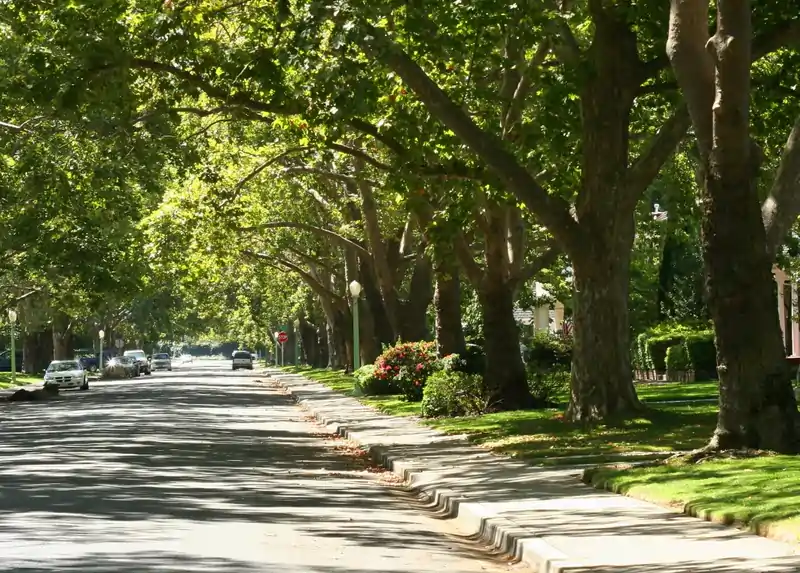
Living in East Sacramento, especially in iconic neighborhoods like the Fab Forties, means living under one of the country’s most beautiful urban forests. Those towering, mature oaks and elms are the heart of the community, but they can also have a hidden, dark side: they may be the primary cause of your foundation problems.
If you’re noticing new cracks in your plaster, sticking doors, or sloping floors, it’s easy to blame “old house” problems. The truth is often more complex, and it’s likely rooted in the combination of your beautiful trees and our region’s notorious soil.
This guide will explain how this happens, what signs to look for, and how foundation underpinning provides the only permanent solution.
The Real Culprit: How Trees and Clay Soil Conspire
The problem isn’t just the trees. The problem is the expansive clay soil that most of Sacramento is built on.
Think of this soil as a dense sponge. When it’s wet during the rainy season, it swells and expands. During Sacramento’s long, hot, and dry summers, it shrinks, hardens, and cracks.
Now, add a large, mature tree to the equation. A single large oak can act as a giant straw, drinking 50 to 100+ gallons of water per day from the soil.
During a dry summer, these trees will pull all the available moisture from the soil under and around your home’s foundation. This causes the clay soil to shrink dramatically in those specific areas. As the soil shrinks, it creates a void, and the section of your foundation above it sinks into the empty space.
This process is called differential settlement, where one part of your house sinks while another stays put. This uneven movement is what pulls your foundation apart over time.
It’s not just Oaks and Elms. The iconic London Plane trees lining streets like J and M Street are notorious for thirsty root systems. Furthermore, because Sacramento City Code strictly protects these heritage trees, removal is rarely an option.
Underpinning allows you to permanently stabilize your home without fighting city hall or losing the shade that keeps your home cool.
Warning Signs: What to Look For
This differential settlement will show clear, visible symptoms inside and outside your home.
- Stair-Step Cracks in Brick: This is a classic sign of foundation issues. These types of cracks are especially common on the older brick homes and chimneys in East Sacramento. The cracks will zigzag up the wall, following the mortar joints.
- Cracks in Walls: Look for new, diagonal cracks spreading from the corners of doors and windows.
- Sticking Doors and Gaps in Windows: When your foundation sinks, it twists the entire frame of your house, causing doors and windows to jam in their “out-of-square” frames.
- Sloping or Sagging Floors: You may feel like you’re walking “downhill,” or a ball might roll to one side of the room.
- A Leaning Chimney: Chimneys are often built on their own separate footing, making them the first and most obvious victim of soil shrinkage.
The Telltale Clue: Are these signs worse on the side of the house with the large, mature tree? If so, you’ve almost certainly found the cause.
The Million-Dollar Question: Will Insurance Cover This?
One of the first questions we get from concerned East Sacramento homeowners is, “Since this damage was caused by a tree I didn’t plant (or the City’s tree), will my homeowners insurance pay for the repairs?“
We want to be transparent with you: In most cases, the answer is no.
While every policy is different, and we always recommend checking your specific Declarations Page, here is why insurance companies typically deny these claims:
- The “Earth Movement” Exclusion: Insurance policies are designed to cover “sudden and accidental” damage—like a tree falling on your roof during a storm. However, foundation damage caused by roots is classified as “Subsidence” or “Earth Movement”. Because the roots slowly drank the water and caused the soil to shrink over years, insurers view this as a gradual process rather than an accident, and “Earth Movement” is a standard exclusion in almost every California policy.
- The “Maintenance” Argument: Insurers often view root intrusion as a maintenance issue. Their argument is usually that the homeowner had time to trim the tree, install root barriers, or manage the soil moisture before the foundation cracked. Therefore, they often categorize the damage as “preventable neglect.”
- The Rare Exception: “Ensuing Loss”: There is one specific scenario where you might find partial coverage. If a tree root wraps around your main water line or sewer lateral and snaps it, causing a sudden flood that ruins your hardwood floors, insurance may pay to replace the floors (the “Ensuing Loss”). However, even in this case, they typically will not pay to remove the tree or fix the foundation that settled.
A Note on City Trees: If the damage is clearly caused by a City of Sacramento street tree (like the massive Elms on the numbered streets), you cannot file a claim with your own insurance, but you may have a liability claim against the City. However, these are legally complex and often require proving you notified the City of the danger years in advance.
The Bottom Line: You cannot rely on an insurance check to save your foundation. The longer you wait for a claim that likely won’t come, the more expensive the physical repair becomes.
The Permanent Solution: A Guide to Foundation Underpinning
You don’t have to choose between your beautiful trees and your home’s stability. Patching the cracks is just a temporary cosmetic fix, they will return. The only permanent solution is to address the root of the problem: the unstable soil.
Underpinning a foundation is the process of bypassing the unstable, “thirsty” clay soil and extending your foundation down to solid, load-bearing ground that is unaffected by moisture changes.
This process essentially gives your home a new, deep, and permanent foundation using high-strength steel piers.
How We Choose the Right Piers
As underpinning experts, we use two primary types of piers, and we select the right one for your home’s specific needs:
- Push Piers: These are the workhorses for heavy, existing structures. We use your home’s own weight to hydraulically drive rugged steel pipes deep into the earth until they hit “practical refusal”, a layer of bedrock or soil so dense it can permanently support your home.
- Helical Piers: These are like giant steel screws that are ideal for stabilizing lighter structures, such as porches or home additions. They are “screwed” into the ground until they reach a specific, engineered torque, guaranteeing their stability.
Our Underpinning Process: How We Restore Your Home
Underpinning is a precise, surgical foundation repair that doesn’t require a massive excavation.
- Evaluation: First, we conduct a full foundation settlement evaluation, using a high-precision altimeter to map your floor’s elevations. This tells us exactly where the sinking has occurred.
- Excavation: We dig small, strategic holes at specific points around the exterior of your foundation, preserving your landscaping.
- Driving Piers: We install heavy-duty steel brackets to your foundation’s footing and drive the steel piers deep into the ground until they are anchored in solid, stable strata.
- Lifting & Stabilizing: Powerful hydraulic jacks are connected to the brackets. We then carefully and uniformly lift the settled portions of your home back towards their original position. The load of your home is then permanently transferred to the piers, and the excavation sites are restored.
Don’t Blame the Trees. Protect Your Foundation.
The trees are what make East Sacramento one of the most desirable neighborhoods in California. You shouldn’t have to sacrifice them for a stable home.
If you see sticking doors, wall cracks, or sloping floors, don’t wait for the problem to get worse. Contact Pinnacle Home Services today to schedule a comprehensive foundation evaluation. We’ll find the true cause of the problem and design a permanent solution to protect your home for a lifetime.