
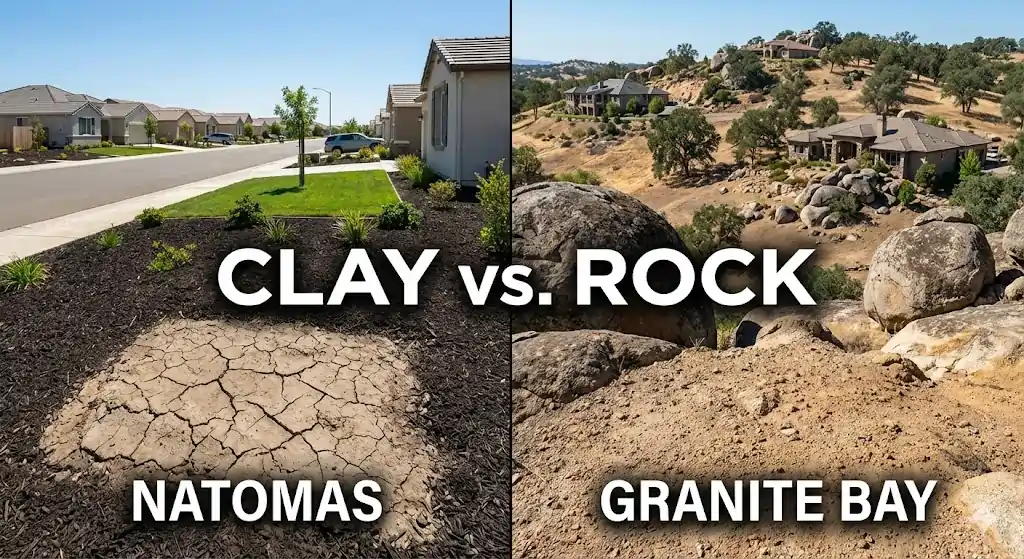
When we talk about “Sacramento foundation repair,” we aren’t talking about a single, uniform landscape. The geography of the Greater Sacramento region is surprisingly dramatic. In less than 15 miles, you can drive from an ancient river basin that sits below sea level to rocky, granite-studded foothills.
For a homeowner, this geological diversity matters immensely. A home built in the master-planned communities of Natomas faces a completely different set of threats than a custom estate in Granite Bay. The soil composition, the water table, and the way the earth moves under the weight of a house are polar opposites in these two locations.
At Pinnacle Home Services, we believe that effective foundation repair starts with understanding the ground you are standing on. A repair method that works perfectly in the soft silt of the valley floor might fail catastrophically in the rocky terrain of the foothills.
In this guide, we will take a deep dive into the “Tale of Two Soils.” We will compare the deep, alluvial clays of Natomas against the shallow, rocky bedrock of Granite Bay, explaining exactly how these differing environments can damage the foundation of homes and how we fix them.
The Great Divide: Valley Floor vs. Foothills
To understand your home’s foundation, you have to look back millions of years. The Sacramento Valley is essentially a massive trough that has been filled in over eons by sediment washing down from the Sierra Nevada mountains.
- Natomas (The Basin): Natomas is located in the heart of the Sacramento River’s historic floodplain. For thousands of years, every time the river flooded, it deposited layers of silt, sand, and organic material. This soil is deep, soft, and geologically “young.”
- Granite Bay (The Shelf): As you move east toward Roseville and Granite Bay, you are moving out of the sediment trough and onto the actual geologic shelf of the Sierra Nevada. Here, the soil is thinner, the bedrock is closer to the surface, and the terrain is defined by massive granite formations.
This geological divide creates two completely different “soil profiles.” Understanding which profile your home sits on is the first step in diagnosing why your drywall is cracking or your floors are sloping.
Deep Dive: Natomas and the Challenges of the Basin
If you live in Natomas (spanning from the older areas near the Garden Highway to the newer developments of North Natomas), you are living on land that, historically, was underwater for much of the year.
While modern levees and drainage systems keep the area dry, the soil underneath tells a different story. Natomas is characterized by alluvial soil, which is composed of deep layers of clay, silt, and sand.
1. The Problem of Subsidence and Compressive Soil
The primary enemy of foundations in Natomas is subsidence. Because the soil is composed of fine river silt and organic matter, it is highly compressible. When you build a heavy structure (like a two-story stucco home) on top of soft soil, the weight of the house can slowly squeeze the air and water out of the dirt below.
Over time, this causes the house to sink. Unlike rocky soil, which stops settling once it hits a hard layer, the deep, soft soils of Natomas can allow a home to settle continuously over decades if the foundation wasn’t properly engineered with deep enough pilings.
2. The “Shrink-Swell” Cycle of Expansive Clay
Much of the valley floor is rich in expansive clay. This clay acts like a sponge.
- Winter: It absorbs the heavy rains, swelling up and exerting thousands of pounds of hydrostatic pressure against your foundation. This can lift (heave) a house upward.
- Summer: During our scorching 100-degree summers, that clay dries out and shrinks violently.
This cycle creates a “yo-yo” effect. In Natomas, we often see homes where the perimeter of the foundation (which is exposed to the sun and dry air) sinks, while the center of the house (protected by the slab) stays put. This differential movement snaps concrete slabs and tears framing apart.
3. The High Water Table
In many parts of Natomas, the water table is surprisingly high. Even if the surface is dry, water may be lurking just a few feet down. This creates a risk of hydrostatic pressure pushing up against slab foundations. If there are any cracks in your moisture barrier, this water can wick up into the concrete, causing efflorescence (white powder), rotting floor coverings, and mold issues inside the home.
Deep Dive: Granite Bay and the Battle with Bedrock
Drive twenty minutes east on I-80, and the rules of physics seem to change. Granite Bay, Loomis, and parts of East Roseville are defined by Decomposed Granite (DG) and shallow bedrock.
You might think building on rock is safer than building on silt, and generally, rock is a great load-bearing material. However, foundation repair in Granite Bay presents a unique phenomenon known as “The Hardpoint Problem.”
1. Differential Settlement due to Hardpoints
In Granite Bay, the bedrock is uneven. Imagine a subterranean mountain range buried just a few feet under your lawn.
- One corner of your house might be resting directly on a solid granite boulder (a hardpoint).
- The other corner of your house might be resting on five feet of softer, decomposed granite soil.
When the soft soil compresses or washes away, the corner on the soil sinks. The corner on the rock does not move an inch. This creates severe differential settlement. The house literally twists because one part is anchored to stone while the rest is floating on shifting dirt. This often results in jagged, diagonal cracks in stucco and drywall that are far more severe than simple settling.
2. Subterranean Water Flow
Water behaves strangely in the foothills. In the valley, water soaks down. In Granite Bay, water hits the impenetrable granite layer and moves sideways.
During heavy rains, water flows downhill, traveling along the top of the bedrock layer just a few feet underground. If your home is cut into a hillside, this subterranean river can run right into your foundation walls. We frequently see Granite Bay homes with mysterious water intrusion in semi-basements or crawl spaces, even when the surface of the yard looks well-drained. The water is attacking from underneath, sliding along the granite shelf.
3. Erosion of Decomposed Granite
Decomposed Granite (DG) is the crumbly, sandy material that results from granite weathering. While it packs down hard, it is highly susceptible to erosion. If your Granite Bay home has poor gutter drainage, the runoff can wash the DG out from under your footing very quickly, leaving the concrete slab hanging in mid-air.
Visualizing the Damage: How Signs Differ by Region
Because the soils move differently, the “foundation warning signs” your house displays will often differ depending on your zip code.
Signs You Might See in Natomas (95834, 95835)
- The “Disappearing” Patio: Because the house is heavy and usually on a deep foundation, it might stay stable while the lightweight concrete patio next to it sinks into the soft silt. We often see patios that have dropped 2-3 inches below the sliding glass door track.
- Driveway Separation: Similar to patios, the driveway on expansive clay will heave and settle seasonally, often creating a “lip” or trip hazard where it meets the garage floor.
- Sticking Doors on the Exterior Walls: As the perimeter of the slab curls down due to soil shrinkage, exterior doors are usually the first to jam.
Signs You Might See in Granite Bay (95746)
- Vertical Cracking in Stem Walls: Because these homes are often on raised foundations or “stepped” foundations to accommodate slopes, you may see vertical cracks in the concrete walls where the house is trying to break its back over a hard granite rock.
- Water Seeping Through Concrete: In homes built into slopes, you might see dark water stains or white mineral deposits (efflorescence) appearing halfway up a retaining wall or foundation stem wall.
- Interior Floor Humps: If a rock formation pushes up (or the rest of the house sinks around it), you can sometimes feel a distinct “hump” or high point in the floor that feels like a solid object underneath the subfloor.
Foundation Repair Methodologies: Why “One Size” Does Not Fit All
This is where the expertise of Pinnacle Home Services becomes critical. A foundation contractor who tries to use the exact same foundation repair plan in Natomas as they do in Granite Bay is setting the homeowner up for failure.
Repairing the Natomas Foundation
In the deep, soft soils of the basin, we have to go deep.
- The Solution: Steel Push Piers.
Because the top layers of soil are soft “mush,” shallow repairs won’t work. We use hydraulic rams to drive steel pipe sections down, often 30, 40, or even 50 feet or more until we bypass the soft river silt and hit the dense, load-bearing strata (“Practical Refusal”) deep underground. - The Goal: We are essentially putting your house on stilts in a process called foundation underpinning. We transfer the weight of the home off of the shrinking clay and onto the deep, stable earth that never changes.
Repairing the Granite Bay Foundation
In the foothills, depth isn’t always the issue, consistency is.
- The Solution: Drilled Piers or Helical Piers.
Sometimes, we can’t use push piers because we hit a granite boulder just 3 feet down. But that boulder might not be big enough to support the house, it might just be a “floater.” In these cases, we may need to use Helical Piers (which screw into the earth) to ensure we are locked into the soil, or we might need to drill through loose rock to reach a stable layer. - Drainage Management: In Granite Bay, repair almost always involves water management. We often install French drains and curtain drains to intercept that “subterranean river” moving down the slope before it can scour out the soil under the home.
The Role of Construction Eras
Beyond geology, the age of the home plays a massive role in this comparison.
Natomas saw a massive construction boom in the early 2000s. Many of these homes are built on Post-Tensioned Slabs. These are high-tech foundations reinforced with steel cables tightened to thousands of pounds of pressure.
- The Risk: You cannot just cut into a post-tensioned slab to fix a plumbing leak or a crack. Cutting a cable can be explosive and destroy the foundation’s integrity. We specialize in identifying and carefully working around these tensioned systems.
Granite Bay features many custom homes built from the 1980s through the 2000s. These are often complex, multi-level structures with “stepped” foundations that climb up a hill.
- The Risk: The “cold joints” where one level of the foundation meets another are weak points. As the hill creates soil creep (gravity slowly pulling the soil downhill), these joints are often the first place to separate.
Conclusion: Local Knowledge Matters
When you are dealing with your home’s foundation, geology is destiny. The forces acting on a home in the Natomas floodplain are fundamentally different from the forces acting on a home in the Granite Bay foothills.
At Pinnacle Home Services, we don’t just sell piers; we solve geological problems. We know that in Natomas, we need to fight subsidence and expansive clay. We know that in Granite Bay, we need to manage erosion and hardpoint stress.
If you are noticing cracks, sloping floors, or doors that won’t close, don’t settle for a foundation contractor who offers a generic fix. You need a solution engineered for your specific zip code and soil type.
Are you unsure if your soil is the culprit?
Contact Pinnacle Home Services today for a comprehensive foundation inspection. Whether you are on the valley floor or the granite shelf, we have the tools and the experience to stabilize your home for good.
Key Takeaways for Homeowners
|
Feature |
Natomas Area |
Granite Bay Area |
|
Primary Soil Type |
Alluvial Silt & Expansive Clay |
Decomposed Granite & Bedrock |
|
Main Threat |
Subsidence & Shrink/Swell Cycles |
Erosion & Differential Hardpoints |
|
Water Issue |
High Water Table (Hydrostatic Pressure) |
Subterranean Runoff (Slope flow) |
|
Foundation Style |
Post-Tensioned Slabs (Common) |
Raised & Stepped Foundations |
|
Repair Focus |
Deep Push Piers to bypass soft soil |
Stabilization & Slope Drainage |