
If you live in Rocklin, you likely moved here for the topography. Unlike the flat, grid-like streets of downtown Sacramento or the floodplains of Natomas, Rocklin offers rolling hills, stunning views of the Sierra foothills, and distinct granite outcroppings that give the city its name.
Neighborhoods like Stanford Ranch, Whitney Oaks, and the ridges above Clover Valley are defined by these beautiful elevations.
But for homeowners, this terrain comes with a hidden cost.
The very geography that makes Rocklin beautiful, the steep slopes, the granite bedrock, and the engineered hillsides, creates a perfect storm for a specific type of structural failure known as “Cut and Fill” Settlement.
While homeowners in other parts of the county worry about soft clay, Rocklin homeowners face a more complex battle: the war between rigid bedrock and shifting fill dirt. If you are noticing cracks in your drywall, doors that stick on the “downhill” side of your home, or a retaining wall that is slowly tipping over, you aren’t just dealing with old age. You are dealing with geology.
This guide will take you beneath the surface to explain why your sinking foundation in Rocklin is happening and how deep structural engineering is the only way to save them.
The "Cut and Fill" Phenomenon: A Rocklin Specialty
To understand why your house is moving, you have to understand how it was built.
Before the housing booms of the 1990s and 2000s, much of Rocklin was rugged, rolling terrain. To build the master-planned communities of Stanford Ranch and Whitney Ranch, developers had to create flat pads on sloped land. They did this using a massive earth-moving technique called Cut and Fill.
How It Works (and Why It Fails)
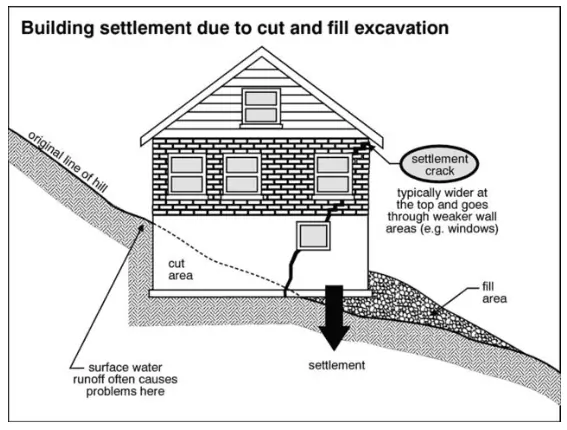
Imagine a sloping hillside. To put a flat house on it, the builder cuts into the high side of the hill (removing earth) and moves that dirt to the low side to build it up.
- The “Cut” Side: Half of your house sits on the part of the hill that was carved out. This soil is usually native, undisturbed, and very hard (often hitting granite bedrock). It creates a rock-solid foundation that never moves.
- The “Fill” Side: The other half of your house sits on the dirt that was moved and packed down to create a level surface. Even with the best compaction equipment, this “fill dirt” is never as stable as the native earth.
The Consequence: Differential Settlement
Over 10, 15, or 20 years, the “fill” side of your lot naturally compresses and settles, while the “cut” side stays rigid on the bedrock.
The result? Your house begins to literally break in half.
In Rocklin, we frequently see homes where the front of the house (on the cut) is perfectly level, but the back bedrooms or the patio (on the fill) are sinking two or three inches. This puts immense torque on your foundation slab, snapping the concrete and tearing the framing apart.
The Effect of Granite
Rocklin isn’t named “Rock-lin” for nothing. The area sits on a massive shelf of granodiorite (granite). While building on rock sounds stable, the depth of that rock varies wildly from one side of your yard to the other. This creates a major drainage issue.
When it rains in Rocklin, water permeates the top layer of soil until it hits the impermeable granite bedrock below. Since the water can’t go down through the rock, it travels sideways along the top of the rock layer.
If your home is built into a hillside, this subterranean water flows down the slope and slams directly into your foundation walls. It pools against the concrete, creating massive hydrostatic pressure.
- In Crawl Spaces: This creates the “swamp under the house” smell common in older Rocklin homes near Pacific Street or Loomis.
- In Slab Homes: The water erodes the “fill” soil out from under your footing, washing away the support for your house one rainy season at a time.
Warning Signs Specific to Hillside Homes
Because of the unique topography in neighborhoods like Whitney Oaks and Stanford Ranch, the signs of foundation failure look different here than they do in flat areas.
1. The “Downhill” Drag
Look at the side of your house that faces the slope or the view. Are the cracks in your stucco vertical, or do they look like a “V” opening up toward the roof? This often indicates that the downhill portion of the foundation is rotating away from the rest of the structure.
2. Separation of Patios and Pool Decks
On cut-and-fill lots, the pool deck or concrete patio is almost always built entirely on the “fill” dirt. It is common to see these slabs sinking 2-3 inches lower than the house foundation, creating a dangerous trip hazard and a path for water to pour right against your stem wall.
3. Retaining Wall Failure
Retaining walls are the unsung heroes of Rocklin real estate. They hold up the “fill” dirt that your neighbor’s house sits on. If you see a retaining wall bulging in the middle, leaning outward, or showing long horizontal cracks, it is a structural emergency. If that wall fails, the soil supporting the home above it goes with it.
4. Chimney Gaps (The Leaning Tower)
Massive masonry chimneys are heavy. If a chimney is built on the “fill” side of the home, it will sink faster than the wood-framed house. Look up at the roofline, is the chimney pulling away from the siding?
Why Standard Foundation Repairs Fail in Rocklin
We often see Rocklin homeowners try to fix these issues with “handyman” solutions that simply don’t work in this geological environment.
Mistake #1: Mudjacking (Poly-Leveling) on Slopes Injecting foam to lift a sinking slab works fine for a driveway in flat Elk Grove. But if your hillside home is sinking because of deep soil creep or slope failure, injecting foam is like putting a band-aid on a broken leg. The foam adds weight to the soil without anchoring it to anything stable. The soil (and the foam) will just keep sliding down the hill.
Mistake #2: Shallow Piers Some contractors will try to use shallow concrete piers. In Rocklin, this is dangerous because you might hit a “floater”, a large granite boulder suspended in the fill dirt. The contractor hits the rock, thinks they hit bedrock, and stops. But the boulder itself is sinking!
The Solution: Deep Foundation Underpinning
To save a home on a Cut-and-Fill lot, you have to bypass the “fill” dirt entirely. You need to connect your foundation to the same solid bedrock that the “cut” side of your house is resting on in a process called foundation underpinning.
We achieve this using Push Piers or Helical Piers.
The Process
- Excavation: We dig down to the footing of your home on the sinking “fill” side.
- Bracket Installation: We attach heavy-duty steel brackets to your foundation.
- Driving to Refusal: We drive steel pier sections down through the unstable fill dirt. In Rocklin, we keep driving until we hit the true granite bedrock layer, whether that is 10 feet down or 40 feet down.
- The Lift: Once the piers are anchored in the granite, we use hydraulic jacks to lift the sunken side of the house.
- Stabilization: We transfer the weight of the home onto the steel piers. Your house is no longer relying on the shifting dirt; it is standing on steel legs resting on solid rock.
Slope Stabilization
For homes with failing slopes or retaining walls, we may use Helical Tie-Backs. These are giant steel screws driven horizontally into the hillside to pull the retaining wall back and lock it into the deep, stable soil behind the slope.
Conclusion: Protect Your Investment and Your View
Living on a ridge in Rocklin is a privilege. The sunsets over the valley and the cool breezes are worth it. But that view requires vigilance.
The soil mechanics of a hillside home are aggressive. Gravity is constantly pulling the “fill” dirt down the slope, taking your foundation with it. Ignoring the signs of settlement, sticking doors, drywall cracks, or uneven floors, can lead to catastrophic structural damage that reduces the value of your property to zero.
At Pinnacle Home Services, we understand the specific “Cut and Fill” geology of Rocklin. We know the difference between hitting a granite boulder and hitting true bedrock. We don’t just patch cracks; we engineer stability.
If you suspect your hillside home is settling, don’t wait for the next rainy season to erode more of your support. Contact us today for a specific foundation repair in Rocklin. Let’s make sure your house is as solid as the granite it’s named after.